
Adoption Is a Trust Problem, Not a Tooling Rollout
Pattern across several orgs, 2024-2026
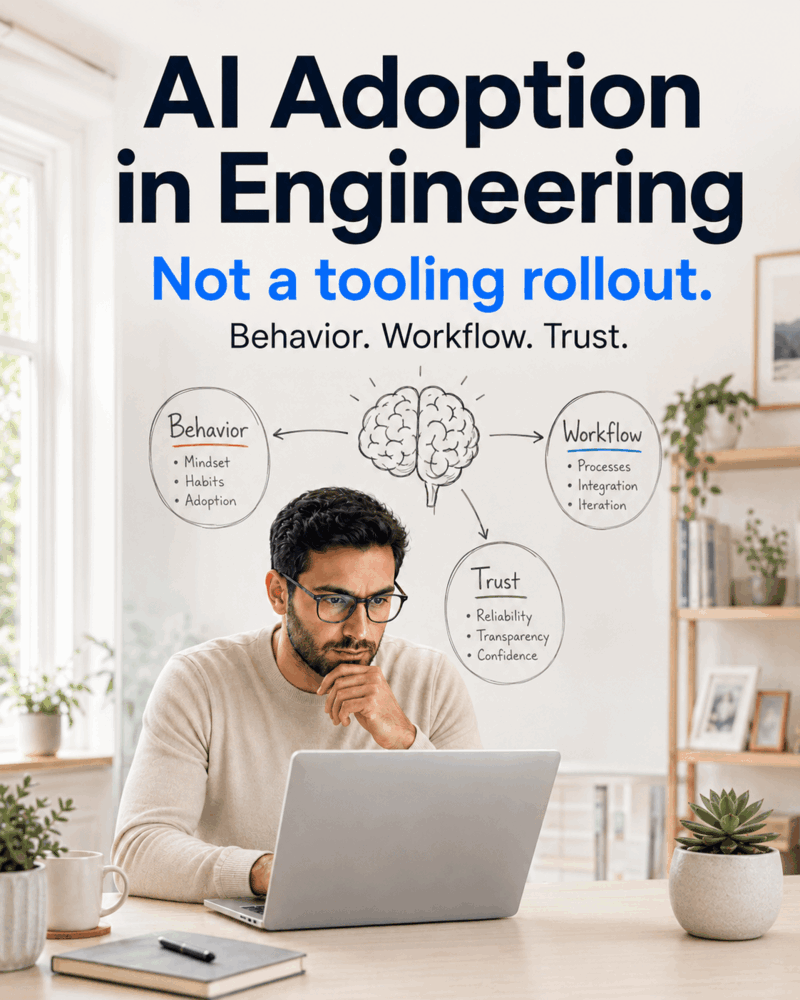
It is a behavior change, a workflow change, and a trust problem wearing a hoodie.
Increasing AI adoption is not about buying more tools. It is about removing the friction between "I should try this" and "this actually helps me ship better software."
Most engineering teams do not have an adoption problem because engineers are resistant. They have an adoption problem because leadership rolls out AI like a corporate wellness program.
Start where the pain already has budget
Do not lead with "here is our AI strategy." Lead with where we are losing time, where reviews are slow, where tests break trust, where onboarding hurts, and where developers are doing repetitive work a machine can handle badly at first and well with guardrails.
Make it part of the workflow
If engineers have to leave the IDE, context switch, paste code into five tools, and reconcile the output by hand, adoption dies. The best AI tooling feels like infrastructure, not homework. It lives inside the SDLC - requirements, architecture, coding, testing, review, security, CI/CD, documentation, incident response - not as a demo, as a pipeline stage.
Guardrails, not handcuffs
Engineers need clear rules about what data can be used, what tools are approved, what requires review, and what must be verified before merge. The goal is not to move fast and hallucinate things. The goal is to move faster with evidence.
Write those rules before the rollout, not after. Retroactive policy lands after habits have formed and costs more to enforce, and the habit it usually finds is shadow AI: engineers on personal accounts, where nothing is logged and the training opt-out you negotiated for the company plan does not apply. An approved tool list under company-managed accounts, a data classification that says what may enter a prompt, and an exception process with a turnaround fast enough that it never becomes the on-ramp to the shadow tools. That is the whole first draft, and it fits on a page.
Measure outcomes, not vibes
Adoption is not measured by license count. Cycle time, review speed, test coverage, escaped defects, onboarding time, incident triage, toil, developer flow - those are measures. If the metric is "we bought 200 seats," congratulations, procurement had a sprint.
Two rules that go with it. Capture the baseline before adoption, because a number without a pre-AI baseline is a story, not evidence; if a clean one does not exist, say so in every report rather than back-filling. And never report adoption percentage, AI-authored lines, or suggestions accepted as success, because they go up while quality goes down. McKinsey's State of AI surveys have 88 percent of organizations using AI somewhere and about 6 percent seeing a material return on it, and the difference between the two groups is not usage. The high performers are roughly three times as likely to have redesigned the workflow around the tool. Everyone else bought seats and kept the process.
Treat skepticism as a feature
A skeptical engineer is not blocking progress. They are protecting production. The data backs the instinct: in Qodo's 2025 survey, engineers with ten or more years of experience were far less willing to ship AI-generated code unreviewed than juniors were, about 26 percent against 60, and in the 2026 edition only 3.7 percent of engineering leaders called their existing processes sufficient as agents take on more work. The skeptics are the people who carry the pager. Bring them in early, let them test the limits and find the sharp edges, then use that feedback to make adoption safer and more useful. If There's So Little Risk, Why Wait? is what that looks like when it works.
Adoption does not scale through hype. It scales through trust, workflow integration, visible wins, and engineering judgment.
What the trust has to be placed in, the pipeline side of the same change, is laid out in An Operating Model, Not a Tooling Purchase.